Walkthrough agenda
Four priority areas for the window before the oral presentation on October 24, and what has been completed on each.
ESMO project plan
43 activities across 8 workstreams, dated from August 18 through the BLA filing, with 8 milestones. Narrative, KOL, advisory board, oral support, booth and surround sound, thought leader meetings, congress execution, post-ESMO.
On the call: the sequencing rationale, the four milestone dates and what depends on them, and which activities need a Compass decision to start.
KOL explorer
34 physicians ranked by designation across cholangiocarcinoma, gallbladder and ampullary — 8 covering all three subtypes, 3 on the NCCN panel, 5 COMPANION-002 investigators. Profiled on publications, congress presence, digital activity, pathway affinity and network position. Two worked dossiers and one social-listening analysis of a digital opinion leader whose public critique previews the field's objections.
On the call: how the advisory board slate and the ESMO 1:1 target list come off this set, and whether the Syneos deliverables can be reanalyzed rather than rebuilt.
Scientific platform and pull-through
Four pillars drafted for the September workshop, with the survival pillar in two scenarios pending the data lock. Alongside them, the map of how one source deck feeds ten derivative tactics, each tagged by audience, owner and embargo status.
On the call: what did not work in the current pillars, and confirmation of the single-voice model across medical, corporate communications and investor relations.
ESMO advisory board
Five objectives, a three-hour evening agenda weighted 75 minutes to data review, five questions framed for advisors, and the 2L positioning analysis behind the sequencing objective — including where tovecimig sits against FOLFOX absent a head-to-head.
On the call: whether these objectives match what Compass wants from the twelve advisors, and what level of data access they need for the durability and subgroup questions.
Assumptions
Data basis
All content is built on the April 27, 2026 public disclosures; no non-public data informed the pillars, advisory board questions or positioning analysis.
Oral presentation scope
The oral is assumed to present the complete data set including duration of response, per the April release.
Embargoed data access
Pixacore is assumed to receive tables, listings and figures under confidentiality with enough lead time to build advisory board, booth and press materials before the embargo lifts.
Advisory board parameters
The twelve advisors are assumed to be contracted for an evening session in Madrid following the oral, with contracts covering a workshop format and recording, and a US-weighted slate.
KOL universe
The subtype export is treated as the working universe and was not filtered by specialty (33 of the 66 are surgical), so anything prescriber-facing was filtered to medical oncology.
Regulatory latitude
The filing is assumed to be anchored on response and PFS with OS as a review issue rather than a label requirement.
Preparation schedule — Aug 18 to BLA filing
43 activities in 8 workstreams. Click a workstream to open its activities. Bars show duration; diamonds are milestones. Oral presentation: Saturday, October 24, 1:00 PM.
Source: Compass ESMO preparation Gantt (Suneil recommendations). Timeline spans Aug 18 – Dec 20, 2026.
BTC KOL roster — 34 physicians by subtype designation
Union of the cholangiocarcinoma, gallbladder and ampullary exports. Designation tier per subtype: G global, N national, D diagnostic, E expert. Click any column header to sort.
| # | Physician | Institution | CCA | GB | AMP | Subtypes | Flags | Directory metrics |
|---|
Key
Subtypes
- CCA — cholangiocarcinoma
- GB — gallbladder cancer
- AMP — ampullary cancer
- BTC — biliary tract cancer
Designation tiers
- G — global
- N — national
- D — diagnostic
- E — expert
Other
- NCCN — National Comprehensive Cancer Network panel member
- C-002 — COMPANION-002 investigator
- KOL — key opinion leader
- NPI — national provider identifier
Tier order for sorting: Global > National > Diagnostic > Expert. Directory metrics appear where the physician also appears in the 50-name claims-volume export; the two exports are separate populations and overlap on 6 names. Mark Yarchoan is included as #67 — ranked #89 cholangiocarcinoma (diagnostic tier), below the export cutoff. Names shown in teal link to a full profile.
PixaLens Domain Scoring
Influence scored across five domains, weighted to BTC and tovecimig relevance. Preliminary grading, 1–5 per domain, 25 maximum — not raw export output.
Total influence (of 25) — by domain
Each bar is stacked by the five domain scores.
Domain detail
What each domain measures
Science influence
- BTC and anti-angiogenic (DLL4×VEGF) publications
- Clinical trials — COMPANION-002 weighted highest
- H-index
- NCCN / ASCO / ESMO guideline authorship
Clinical experience
- Academic / NCI-designated CoE affiliation
- BTC diagnosis volume across subtypes
- 2L BTC prescribing
- BTC referral patterns
Industry engagement
- ESMO / ASCO-GI congress presence
- Compass and BTC-oncology payments
- Advisory boards
- CME / med-ed activity
Digital activity
- X followers and posts
- Tovecimig / BTC posts weighted
- Podcasts and OncLive articles
- Identifies digital opinion leaders
Network dynamics
- Co-authorship
- NCCN / guideline committee seats
- Congress networks
- Referral centrality and geographic reach
Preliminary grading against the internal rubric; refine as full data is collected. Items marked [verify] remain pending.
Milind Javle, MD
Scientific influence
- 610 publications
- Prolific, lead-author BTC output
- H-index 73
- Focus: cholangiocarcinoma / BTC systemic therapy
Clinical expertise
- GI medical oncology
- MD Anderson — global centre of excellence
- #1 cholangio (98.1) · #1 gallbladder (93.8)
- Ampullary #83 · 13 clinical trials
Industry engagement
- 319 Open Payments records
- COMPANION-002 investigator and ESMO 459O lead author
- ASCO / ESMO podium leadership
Digital activity
- Digital opinion leader — @JavleMilind
- 1,962 followers · 1,015 posts since 2021
- Moderate BTC data amplification
Network dynamics
- Chair, NCI Task Force Hepatobiliary Cancers
- Ranked in all three BTC subtypes
- National / global reach
- Central COMPANION-002 network node · MD Anderson BTC hub
The #1-ranked cholangiocarcinoma and gallbladder KOL in the country and the lead author / investigator on COMPANION-002 — the single most important scientific and advisory relationship for tovecimig. Anchor for the ESMO advisory board, publication strategy, and data-narrative validation.
Source: BTC exports (NPI 1831196252) · COMPANION-002 / ESMO 459O · affiliation corrected.
Mark Yarchoan, MD
Scientific influence
- 251 publications
- HCC / hepatobiliary immunotherapy and cholangiocarcinoma
- Active public data interpreter
- H-index 56
Clinical expertise
- GI / hepatobiliary medical oncology
- Johns Hopkins — academic centre of excellence
- Cholangio rank #89 (58.1)
- 3 clinical trials · HCC focus
Industry engagement
- 86 Open Payments records
- AACR Liver Cancer keynote (Dec 2026)
- GI Cancers Symposium 2024 — HCC lecture
Digital activity
- Digital opinion leader — @MarkYarchoan
- 2,549 followers · 772 posts
- COMPANION-002 thread: 3,485 views · 25 likes · 7 reposts
- Sentiment: cautiously skeptical
Network dynamics
- Co-authorship network [verify]
- National reach; Hopkins BTC / HCC hub
- Amplifies practice-changing data to peers via X
A top-90 cholangiocarcinoma KOL and a genuine digital opinion leader who publicly analyses practice-changing BTC data — under-tiered as “diagnostic” by the export relative to his reach. Priority for scientific exchange and digital engagement; his OS and control-arm critiques preview the field's objections to tovecimig.
Source: cholangiocarcinoma export (NPI 1962761080) · @MarkYarchoan (X) · affiliation corrected.
Social listening — Mark Yarchoan on COMPANION-002
X thread, 27 April 2026 · 3,485 views · 25 likes · 7 reposts · 2,549 followers. View the original thread on X →
skeptical
Sentiment by topic
Acknowledges the ORR / PFS win and novel mechanism, but needs more before calling it practice-changing.
Further in the thread
- Anti-VEGF has not moved the needle in BTC; tovecimig's DLL4 + VEGF is a novel target.
- The paclitaxel control arm is not the 2L standard (FOLFOX) — a major concern.
- Recognises the real need for more 2L therapies; patient perspectives matter.
The OS signal and the paclitaxel-control choice are the two objections to pre-empt — in the scientific narrative, MSL resources, and the ESMO advisory board (crossover confounding, RPSFT, 2L unmet need).
Thread screenshot — posts 4 to 6
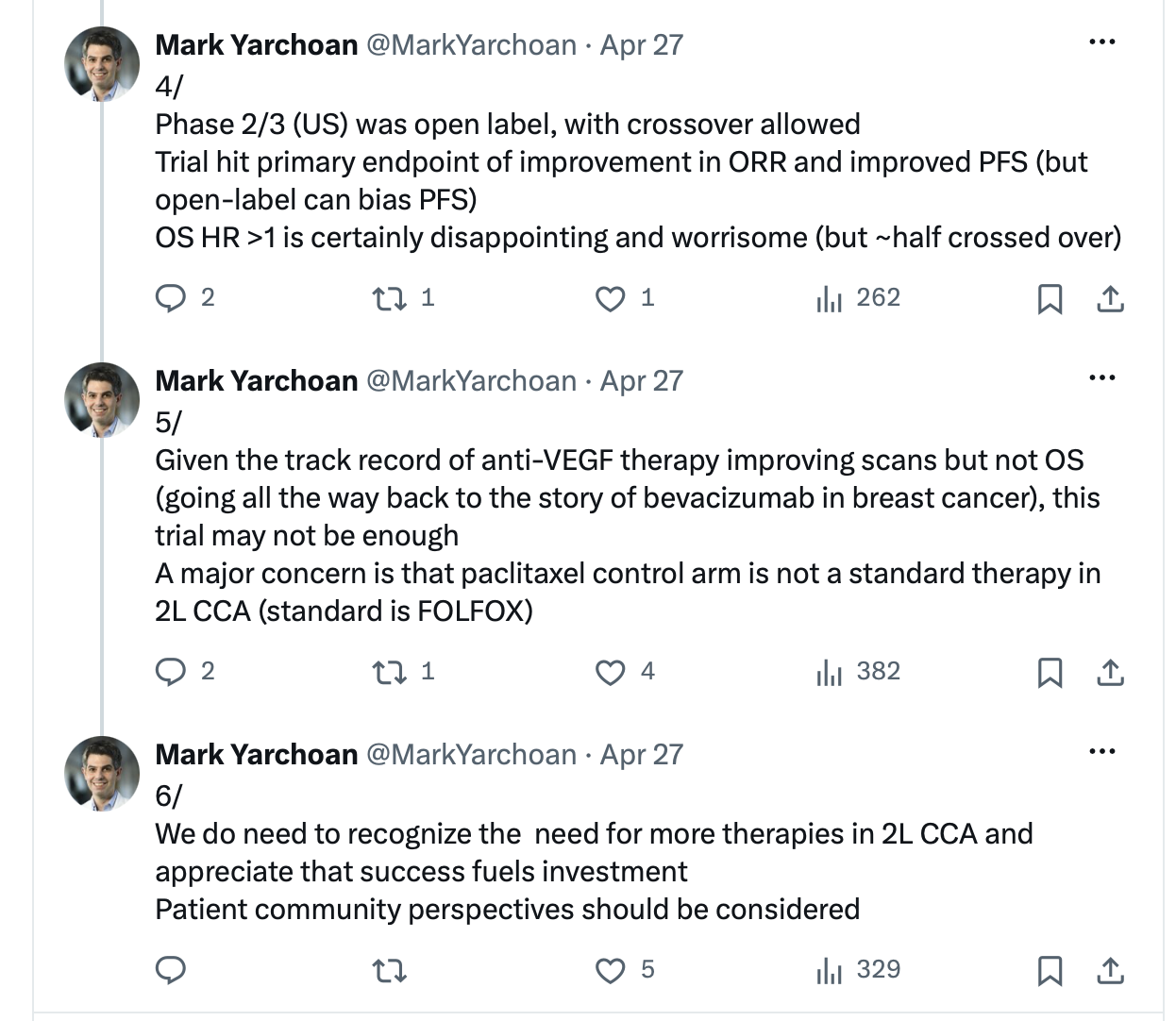
Source: @MarkYarchoan on X, 27 Apr 2026 (screenshot and verbatim) · sentiment coding is Pixacore analysis.
Tovecimig in 2L BTC — four durable pillars
The survival pillar is held in two scenarios pending the ESMO 2026 data lock.
~85% of 2L patients have no actionable mutation and no approved 2L option. Survival on borrowed regimens (FOLFOX, 5-FU/nal-IRI) is ~6 months with ~5% response.
DLL4 is highly expressed in BTC and drives resistance to VEGF-only inhibition. Blocking DLL4 + VEGF-A together targets that escape pathway — no biomarker required.
BICR-confirmed ORR 17.1% vs 5.3% and a 56% reduction in risk of progression or death (PFS HR 0.44) on a familiar taxane backbone, with pre-specified PFS2 support (HR 0.36).
Profile led by hypertension and neutropenia (grade ≥3 related 44% / 36%), no new signals in disclosures, and a monitoring algorithm built for community infusion suites.
Survival pillar — held in two scenarios pending ESMO 2026 data lock
SCENARIO A · OS less of a headline
The full data set (duration of response, subgroups by primary site, post-progression therapy) gives the field enough context that OS stops leading the discussion. Response and PFS carry the narrative. The crossover analysis reads as supporting evidence rather than a defense, and MSL materials lead with benefit-risk.
SCENARIO B · OS remains a headwind
OS is the first question in every exchange. The crossover analysis becomes standing content in the platform, the ad board deck and MSL objection handling rather than a reactive answer. Named studies carry the forward argument: real-world characterization of the 2L population, subgroup analyses by primary site, and the 1L combination.
Source: Tovecimig Medical Affairs scientific-platform working draft · pillars to be pressure-tested at the ESMO advisory board.
Message pull-through — source deck to derivative tactics
The oral presentation deck is the source. Every derivative tactic is a cut of the same tables, listings, figures and message set, adapted by audience and embargo status.
Core data set
Tables, listings and figures from Compass. Candidate messages aligned with Regulatory, CorpCom, R&D and the CMO.
Milestone: narrative locked · Sep 22
Oral presentation
Drafted from the TLFs, reviewed by the PI, presented Saturday Oct 24 at 1:00 PM. Every downstream asset is cut from this deck.
Milestone: finalized · Oct 13
Post-oral
Post-oral
Pre-embargo
Post-embargo
Post-oral
Both
During
Post-ESMO
Post-ESMO
Post-ESMO
Ownership by function
Derivative tactics
| Derivative | Cut from | Audience | Timing | Owner |
|---|---|---|---|---|
| Ad board deck — core data slides with testable messages in headers and sub-bullets, MOA schematic, reaction scaling | Oral deck | 12 recruited advisors | Oct 24–25 | Pixacore, medical review |
| 1:1 TLE materials — per-KOL briefing sheet, objectives built from the COMPANION-002 data, discussion points | Oral deck + KOL dossiers | Named thought leaders at ESMO | Oct 23–27 | Pixacore |
| Booth pre-embargo — pipeline wall, mechanism, corporate overview, session time and location | Corporate + disease state | Congress attendees | Live Oct 23 | Pixacore + vendor |
| Booth post-embargo — reactive deck and Q&A backgrounder, walked through on request only | Oral deck | Unsolicited queries | After Oct 24, 1:00 PM | Medical-staffed |
| Press release — language consistent with the scientific narrative, ready for Saturday afternoon | Narrative packet | Investors, media | Oct 24 | CorpCom / IR, medical-aligned |
| Social — awareness posts before, reactions and photos after | Narrative packet | HCP and general | Oct 19–27 | Pixacore + CorpCom |
| Scientific communication platform — formalized from messages the advisors validated | Ad board output | MSLs, medical information, publications | Nov–Dec | Pixacore |
| Disease state education — DLL4 and dual-targeting mechanism, 2L unmet need | Platform | Community and academic HCPs | Post-ESMO | Pixacore |
Pre-embargo materials carry no data. Post-embargo booth activity is reactive fulfilment of unsolicited queries only — no proactive promotion of an investigational agent.
- Confirm agency access to tables, listings and figures, and the embargo terms that govern derivative builds.
- Does corporate communications have an agency, or should the press release and website language sit in this scope?
Meeting objectives
Data review anchored by Milind Javle, MD (COMPANION-002 lead author) · advisor slate per the KOL dossiers.
Understand and analyze the COMPANION-002 data package
How advisors weigh an 18% versus 5.3% confirmed response rate and a PFS hazard ratio of 0.44 against an OS hazard ratio of 1.05, in a trial where 54% of the control arm crossed over. What further analyses would make the survival result interpretable.
Define the eligible patient — map 2L BTC practice patterns and unmet need
COMPANION-002 excluded patients eligible for molecularly targeted therapy. How advisors see that population in their own practice — its size, how reliably it is identified, and what they offer it today after first-line cisplatin/gemcitabine with or without a checkpoint inhibitor (durvalumab or pembrolizumab).
Position against existing second-line options for differentiation
Where advisors would sequence tovecimig relative to FOLFOX (ABC-06) and 5-FU/nal-IRI (NIFTY), and what evidence they would need before changing current practice.
Clinical management and open questions
Managing grade 3 or higher hypertension at the observed 52% rate, monitoring expectations in patients with biliary obstruction and stents, and what advisors would still want answered before prescribing.
Education
How advisors would share these data with colleagues — the formats, materials and settings they consider most useful, and what they would need in order to present the findings accurately.
- Will advisors have access to the full data set ahead of the session, and under what confidentiality terms?
- Sequencing versus unmet need: is the board being asked to resolve a sequencing question, or to confirm that COMPANION-002 addresses an unmet need where no approved option exists? The framing changes objectives 2 and 3.
Proposed agenda — approx. 3-hour evening session
Sequenced so the data review sits before any platform work; the workshop follows the discussion it depends on.
| Time | Agenda topic | Lead | Minutes |
|---|---|---|---|
| 6:00–6:10 | Welcome, objectives and confidentiality | Facilitator | 10 |
| 6:10–6:30 | Current 2L BTC landscape and practice patterns | Moderator | 20 |
| 6:30–7:45 | COMPANION-002 data review + fitting tovecimig into the landscape | Moderator | 75 |
| 7:45–7:55 | Break | — | 10 |
| 7:55–8:25 | Scientific platform themes — breakout workshop | Moderator | 30 |
| 8:25–8:55 | Educational resources and practice needs | Moderator | 30 |
| 8:55–9:00 | Closing remarks and adjourn | Facilitator | 5 |
Key discussion questions
Selected from the moderator prep bank and framed as questions to the board.
- Confirm which of these can be asked before the oral presentation and which must wait until after the embargo lifts.
2L positioning — would approval create a sequencing decision?
Working analysis behind advisory board objectives 2 and 4. Position: most treaters would not switch by default, and the debate is not primarily about sequence.
Why it is not a sequencing question
Tovecimig + paclitaxel and FOLFOX occupy the same slot. Roughly a quarter to a third of BTC patients are fit enough to reach a third line, so choosing one usually means the other is never given. The oncologist is picking, not ordering.
Why the pick is not automatic
COMPANION-002 randomized against paclitaxel monotherapy, which is rarely used as 2L in the US, so there is no evidence against the comparator a treater is actually weighing. The paclitaxel arm reached 9.4 months OS against ABC-06's 6.2 months on FOLFOX — a gap that indicates different enrolled populations and argues against using 8.9 months as a comparative figure.
What pulls treaters toward it
- ORR 17.1% vs 5.3% — the highest response rate any randomized 2L BTC trial has produced; FOLFOX gives about 5%. Where tumor bulk drives biliary obstruction and pain, shrinkage has practical value.
- PFS 4.7 months, HR 0.44 — better than FOLFOX (~4.0 months vs ASC) or nal-IRI/5-FU (3.6 months pooled).
- Taxane backbone — patients coming off gem/cis carry platinum resistance and residual neuropathy; skipping oxaliplatin is an easy bedside argument.
- All-comers — after FGFR2, IDH1, HER2, BRAF and MSI-H patients are routed to targeted options, tovecimig competes for the remaining majority.
What pushes back
Grade ≥3 hypertension at 44% is substantial management in patients with stents and cholangitis risk. Biologic pricing against a generic regimen. No duration of response in the topline — which matters both for how FDA treats an ORR-anchored filing and for how KOLs read the 17.1%.
How the OS result is likely to be read
Academic GI oncologists
Follow the crossover reasoning: 54% of controls crossed, 85% of everyone enrolled received drug, and PFS2 (3.5 vs 1.9 months, HR 0.36) is a genuine internal-consistency argument.
Community oncologists, pathway committees, payers
See “missed OS” (HR 1.05) and default to generic FOLFOX.
Likely real-world pattern
Adoption concentrated at academic and high-volume BTC centres, in the patient who needs a response — bulky, symptomatic, declining fast — while community practice stays on FOLFOX until something addresses the OS question.
Three ESMO readouts that would move this
Not in the topline; determines how an ORR-anchored filing is read.
Gallbladder responds to taxanes differently than intrahepatic CCA.
What each arm actually received after progression.
- How does Compass plan to position against FOLFOX absent a head-to-head? This is the question future MSLs will get asked in every call.